


Beyond the Quadrant: What the 2026 Gartner Magic Quadrant for Observability Platforms Actually Means for Your Business
- Jul 17
- 9 min read
The release of the Gartner Magic Quadrant for Observability Platforms on 15 July 2026 tells us plenty about vendor momentum, but it also tells us something more familiar to anyone who has worked in the trenches of this market: the Leaders set the trends, and everyone else follows. That is not cynicism. It is how this space works. The vendors with the biggest teams, the deepest product benches, and the broadest customer estates create the agenda. The rest of the market reacts to it. We do not see that changing any time soon.
With 19 vendors evaluated, this year’s report is more than a leaderboard. It is a stark reminder that the gap between basic monitoring and genuinely operationally intelligent observability is still widening. We have seen this play out before. A capability appears on the edge, the Leaders industrialise it, customers start demanding it everywhere, and suddenly it becomes table stakes.
As the market accelerates toward a projected $14.2 billion valuation by 2028, enterprises are under pressure to separate platform substance from platform theatre. The era of simply collecting telemetry is over. In our view, the 2026 report reinforces a hard truth: AI/ML capabilities, cost-efficiency, and native OpenTelemetry support are no longer differentiators on their own. They are the minimum price of entry in an increasingly unforgiving market.
The Leaderboard: Sustained Dominance and the Signals That Matter
If you have been around this market long enough, you stop reading the quadrant as a beauty parade and start reading it as a set of signals. The obvious part is who is in Leaders. The more useful part is who is holding ground, who is moving with intent, and who has gone strangely quiet.
Vendor | 2025 → 2026 trend | What it suggests |
Dynatrace | 16th year holding | The most durable brand in the quadrant, still setting the standard for enterprise-grade execution |
Datadog | 6th year holding highest Ability to Execute | Operationally formidable, still one of the strongest go-to-market and platform delivery machines in the space |
Grafana Labs | 3rd year furthest in Completeness of Vision, strengthening | Vision continues to outpace much of the market, especially around open-source, OTel, and composability |
Elastic | 3rd year holding | Continued maturity and clear product improvement have kept them firmly in the conversation |
Chronosphere | 3rd year holding | Steady progress and consistency matter in a market that punishes fragmentation |
Coralogix | Moved from Visionary to Leader | The headline mover, rewarded for solving current customer pain in a coherent way |
IBM Instana | Moved up to Leader | A serious move, helped by strong tracing depth and broader IBM platform relevance |
ScienceLogic | Moved up to Leader | Suggests growing recognition for practical execution and broader operational fit |
Splunk/Cisco | No 2026 announcement, likely slipped | Not confirmed by them, but the silence is notable and worth paying attention to |
New Relic | No 2026 announcement, likely slipped | Again, not confirmed data, but the absence of a 2026 announcement is difficult to ignore |
The real story behind the vendor movement
Coralogix is the headline mover. In our view, Gartner rewarded something very specific here: cost-control and AI observability were built into the core platform rather than bolted on afterwards. That matters. We have all seen vendors stitch together capabilities in response to market pressure, and customers usually feel the seams. Coralogix looks more architecturally coherent, and in a market this unforgiving, coherence shows up quickly in product experience and commercial relevance.
Grafana Labs remains on an upward arc. Being furthest in Completeness of Vision for two years was already meaningful. Doing it again and strengthening that position says even more. Their OpenTelemetry-native and open-source foundation is increasingly seen as one of the most forward-looking visions in the market, especially for teams that want flexibility without surrendering future options. The Adaptive Telemetry suite also appears to be landing well because it addresses a problem buyers genuinely have, not a problem invented for a keynote.
Datadog is still holding the top execution spot, and that deserves respect. They know how to deliver at scale, they know how to sell, and they know how to operationalise new capability across a broad platform. But execution and vision are not the same thing. Right now, Grafana Labs has the edge on vision, even if Datadog continues to dominate on Ability to Execute.
Dynatrace remains the most durable brand in the field. Sixteen years in the Leader category is not just a nice milestone for investor slides. It tells you they have managed to stay relevant through multiple market resets. The combination of Davis AI, deep full-stack automation, and enterprise discipline still resonates with large organisations that want a platform they can operationalise at scale.
Elastic deserves the strong shout-out. They have made huge improvements, and it is not cosmetic. They have brought a brilliant product into play at exactly the time the market is demanding stronger search, analytics, and observability convergence. We have seen plenty of vendors struggle to widen perception beyond their historical category. Elastic is doing the opposite. They are broadening the conversation and earning a more serious seat at the table.
IBM Instana is also worth watching closely. The story is not just that they moved up. It is how that move connects to the wider IBM strategy. Instana is increasingly being positioned as a foundation for IBM Concert, which makes this an agentic operations play as much as a pure observability one. Add in full-fidelity unsampled tracing, and you have a proposition that could resonate strongly with enterprises that want depth, context, and a tighter path from detection to action.
ScienceLogic moving up to Leader should not be ignored either. These shifts rarely happen on noise alone. Markets like this reward vendors that keep closing real gaps, listening to customer friction, and improving execution where it counts.
Then there is the silence, which is often more revealing than the press release. Splunk/Cisco is the most interesting data point in the whole quadrant discussion. After three years of celebrating Leader status, there has been no 2026 announcement. That does not prove anything on its own, and we should be clear that this is an inference from absence, not confirmed vendor disclosure. But it is still notable. The Cisco integration created complexity, and Gartner had already flagged that as a caution in 2025. When a vendor goes quiet after years of promoting its position, experienced buyers notice.
New Relic sits in a similar category. There is likewise no 2026 announcement, and again this should be treated as an inference rather than confirmed data. Still, the lack of noise after the 2023 ownership change is worth watching. In this market, silence can simply mean a communications choice. It can also indicate that momentum is not where a vendor wants it to be.
There are also a couple of honourable mentions worth calling out now rather than waiting for consensus to catch up. Dash0 is building serious momentum. Groundcover, in particular, looks like a vendor that will no doubt appear in the 2027 quadrants if the trajectory holds. Why? Not just because of AI, which everyone now wants on the slide deck, but because BYOC and Sovereign AI speak directly to a more serious enterprise concern: safe data, control, and where intelligence actually runs. That is where differentiation is becoming more credible.
What's Driving the Overall Market
Strip away the marketing language and two themes appear to be carrying real weight in the 2026 market.
The first is AI observability. Not AI as a badge. Not AI as a chatbot bolted onto a dashboard. We mean the practical ability to monitor LLMs, agents, prompt flows, inference behaviour, and token costs in a way that operations teams can actually use. That requirement is moving quickly from emerging use case to mainstream expectation. Vendors with native capability here are gaining ground because customers do not want to bolt a second toolchain onto an already crowded observability estate.
The second is cost control. This is not glamorous, but it is immediate. Buyers want better telemetry volume management, tiered storage, and pipeline filtering because ingest costs have become impossible to ignore. The vendors gaining momentum are the ones treating this as a product discipline rather than a pricing footnote.
Put those two themes together and a pattern emerges. Vendors with native capabilities in AI observability and cost control are moving forward. Vendors with fragmented portfolios, especially those assembled through acquisition and then loosely integrated, are under pressure. We have seen this play out enough times to know how it ends. If the architecture feels disjointed, customers feel it first, analysts write it down second, and the quadrant eventually reflects it.
The Intelligence Mandate: AI as a Core Metric
The 2026 evaluation criteria have undergone a significant evolution. AI and Machine Learning are no longer peripheral features; they are now a core pillar of the evaluation framework. Gartner’s shift mirrors what practitioners have been dealing with for some time: the sheer volume of data produced by modern, cloud-native environments has long since outpaced manual analysis.

Operational intelligence is the new goal. It is no longer enough to know that a service is down; the platform must proactively explain why it happened and, increasingly, suggest or even execute a remediation. We anticipate that the next two years will see a transition from conversational AI (asking a bot questions) to agentic AI, where observability tools act as autonomous members of the SRE team.
Can your current toolset distinguish between a transient flicker and a systemic failure before the customer notices? If the answer is no, the 2026 MQ suggests you may be falling behind the momentum of the industry.
Taming the Telemetry Tax: A Focus on Efficiency
One of the most persistent themes in the 2026 report is the unforgiving cost of data ingestion. Gartner highlights that "cost-fatigue" has reached a breaking point. Many organisations are seeing their observability bills grow faster than their revenue. We have seen this repeatedly, and it is exactly why we refer to it as the "Telemetry Tax."

The Leaders in this year's quadrant, particularly Coralogix and Grafana Labs, have made significant strides in providing tools for cost optimisation. This involves more than just cheaper storage; it requires intelligent first-mile processing. By filtering, aggregating, and routing data before it hits expensive long-term storage, enterprises can significantly reduce their TCO without sacrificing visibility.
We have seen many of our clients struggle with the trade-off between depth of data and budgetary constraints. Our approach at Visibility Platforms is focused on helping you implement strategies that reduce log ingest by up to 90% while maintaining the integrity of your incident response capabilities.
The OpenTelemetry Mandate: Native Support is Table Stakes
In 2026, OpenTelemetry (OTel) is no longer an emerging standard; it is the universal language of observability. The Magic Quadrant explicitly rewards vendors that provide native OTel support without a "schema translation tax."
The shift toward vendor-neutral data collection is a direct response to the "lock-in" fears that have plagued the industry for a decade. By adopting an OTel-first strategy, organisations can maintain the flexibility to switch back-end vendors as their needs or the market shifts.
As we have explored in our analysis of OpenTelemetry vs. Vendor Lock-in, the value of your observability practice is in the insights, not the proprietary agent. The 2026 MQ reinforces that the most visionary vendors are those that embrace this open ecosystem.

From APM to Full-Stack Observability Platforms
The 2026 report marks the final stage of the transition from Application Performance Monitoring (APM) to comprehensive Observability Platforms. The distinction is critical. Traditional APM focused on the health of the application code. Modern observability encompasses infrastructure, network assurance, user experience, and security.
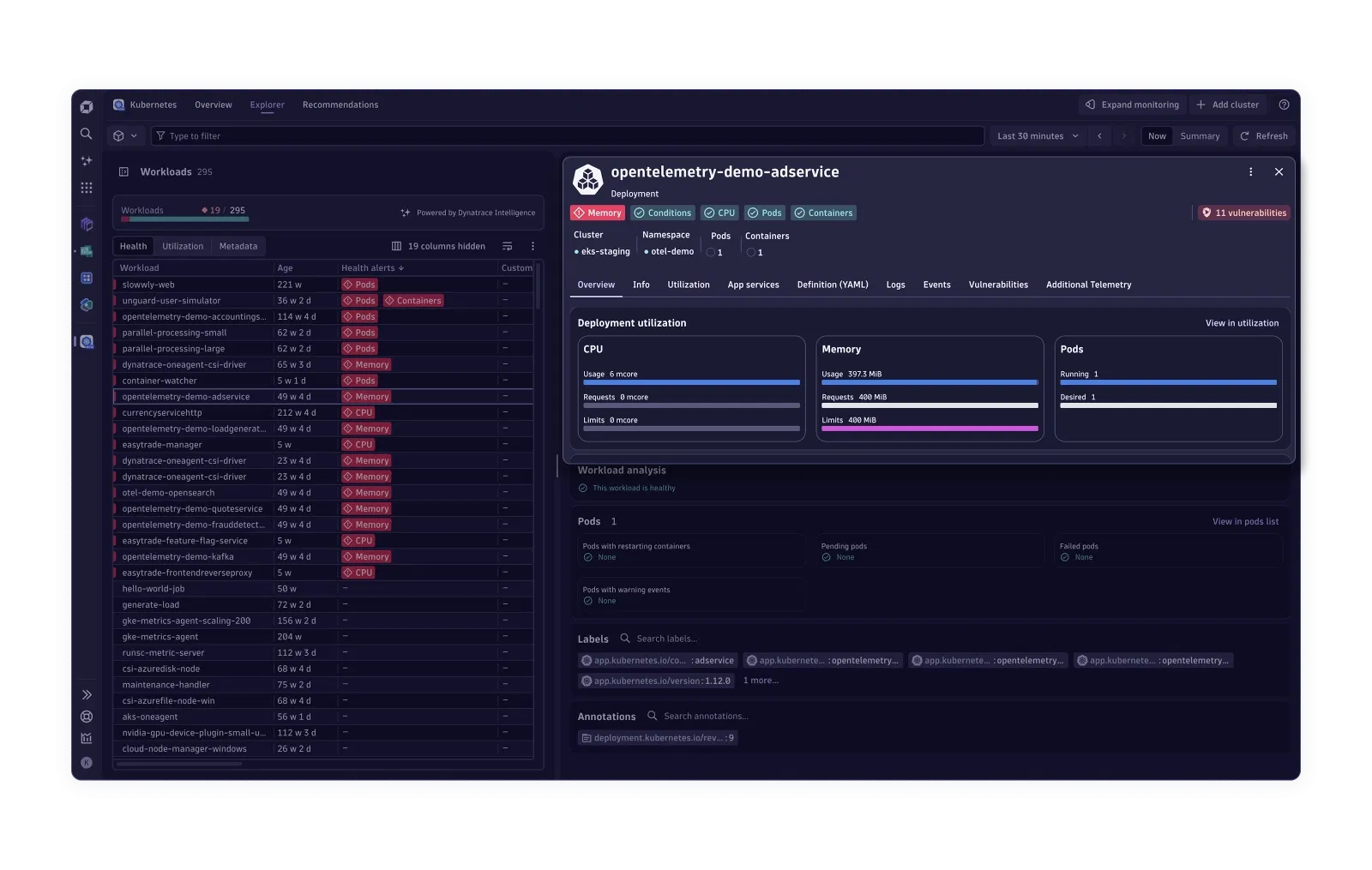
Platforms like Dynatrace and Datadog have long understood this, but we now see Microsoft, AWS, and Oracle aggressively expanding their native monitoring capabilities to capture this market. However, for most global enterprises, a single-cloud native tool is rarely sufficient. The challenge lies in achieving a unified view across a fragmented, multi-cloud landscape.
Whether you are managing Kubernetes performance or ensuring network assurance, the 2026 MQ serves as a guide for selecting a platform that can grow with your operational maturity.
Cutting Through the Noise: A Strategic Path Forward
While the Gartner Magic Quadrant is an invaluable tool for market analysis, it should not be the sole driver of your procurement strategy. A vendor’s position in the "Leaders" quadrant does not automatically make them right for your technical debt, your operating model, or your budget.
There is another hard truth here. Vendors need to actually listen to customers, and they need to pay close attention to the "cautions" sections in the MQ. That is where the real signals often sit. If a vendor keeps hearing the same customer criticism and does nothing meaningful about it, the market eventually catches up with them. Momentum fades, quadrant recognition slips, and once that starts, recovery is not guaranteed. We have seen this play out enough times to know it is not theoretical.
In our view, the most successful organisations treat the MQ as a map, not a mandate. Selecting an observability platform is a multi-year commitment that shapes engineering workflows, incident response, financial control, and operational maturity. Can you do more with less? Can your platform strategy survive the next procurement cycle, the next cost review, and the next major incident? Those are the questions that matter.
If you are looking to optimise your monitoring investments, reduce unnecessary ingest, or get sharper during critical incidents, we can help. At Visibility Platforms, we work as an extension of your team, bringing vendor-neutral guidance and hands-on engineering support grounded in what actually works in live environments.
The 2026 landscape is moving rapidly, and the wrong platform decision lingers for years. Speak to our experts for a strategic consultation. We can help you assess these vendors against your real use cases, your constraints, and the maturity level you actually want to reach.
Visibility Platforms: Helping you make data-driven decisions through unmatched observability expertise.
Comments